

Table of Contents
- Why Wrinkle-Free Travel Shirts Matter for Experienced Travelers
- The Best Wrinkle-Resistant Fabrics for Travel
- Chemical vs. Mechanical Wrinkle Resistance: What the Label Doesn't Tell You
- How to Pack Shirts Without Wrinkling
- Travel Apparel Care and Maintenance on the Road
- Weight-to-Wrinkle Ratio: Finding the Sweet Spot for Carry-On Travel
- Odor Resistance and Sustainability in Modern Travel Shirts
- Frequently Asked Questions
Last Updated: September 20, 2026
Why Wrinkle-Free Travel Shirts Matter for Experienced Travelers
Travel shirts that do not wrinkle solve a specific problem: looking presentable at a café in Bologna or a museum in Vienna without hunting for an iron.
The Best Wrinkle-Resistant Fabrics for Travel
The best wrinkle-resistant fabrics for travel fall into two families: natural fibers with built-in recovery, and synthetic blends engineered for smoothness. Each trades off breathability, feel, and care.
Natural Fibers: Merino Wool and Tencel
Merino wool resists creasing because its fibers spring back after compression (Wool Fibre Properties, Facts & Benefits). It also regulates temperature and resists odor, which suits long train rides and cool evenings.
Synthetic Blends: Polyester, Nylon, and Elastane
Polyester is the workhorse of no-iron clothing. Its fibers hold their shape, which is why so many travel shirts use it as a base.
| Fabric | Wrinkle Resistance | Breathability | Drying Speed | Best For |
|---|---|---|---|---|
| Merino wool | High | High | Moderate | Cool climates, multi-day wear |
| Tencel | Moderate | High | Fast | Warm days, dressier looks |
| Polyester blend | High | Moderate | Fast | Carry-on packing, low maintenance |
| Nylon blend | High | Moderate | Very fast | Humidity, quick laundry |
Chemical vs. Mechanical Wrinkle Resistance: What the Label Doesn't Tell You
Wrinkle resistance works in two fundamentally different ways, and the label rarely says which one you are buying. Knowing the difference helps you predict how a shirt feels on day one, how it behaves after twenty washes, and whether it suits the way you travel.
Chemical Finishes: Bonded Smoothness
Chemical wrinkle resistance comes from a finish applied after weaving. The most common family, durable-press or permanent-press chemistry, cross-links cellulose fibers, cotton and rayon especially, so they hold their shape instead of folding along a crease. Treated cotton can feel stiffer at first, loses some breathability, and the finish gradually washes out. Some shoppers also prefer to limit exposure to formaldehyde-based chemistry, which is why "wrinkle-free" labels on cotton sometimes carry a care note about washing before first wear.
Mechanical Resistance: Built Into the Structure
Mechanical wrinkle resistance comes from the fiber, the yarn, and the weave. Three levers do most of the work:
- Fiber recovery. Polyester, nylon, and merino wool are naturally resilient, their molecular structure springs back after compression. Cotton and rayon are not, which is why they are usually blended or finished.
- Weave tightness. A tight plain weave resists creasing better than a loose oxford or a twill with a pronounced diagonal, because there is less room for yarns to shift and set a fold line.
- Blend ratio. A 60/40 polyester-cotton blend behaves very differently from a 95/5. The higher the synthetic share, the more the fabric relies on inherent recovery rather than chemistry.
Why Most Shirts Use Both
In practice, the two approaches combine. A polyester-cotton button-down may carry a light permanent-press finish and a tight weave and a touch of elastane. That layering is not a marketing trick, it is how manufacturers hit a target hand feel, drape, and price point at once.
How to Read a Label for Clues
A few signals tell you which path a shirt took:
- "Wrinkle-free" or "no-iron" on a mostly cotton shirt usually means a chemical finish.
- "Wrinkle-resistant" on a polyester or nylon blend usually means mechanical.
- A care tag that says "wash before wearing" on a cotton shirt is a hint that a finish is present.
- A fabric content list heavy in polyester, nylon, or merino, with no finish claim, points to mechanical resistance.
How to Pack Shirts Without Wrinkling
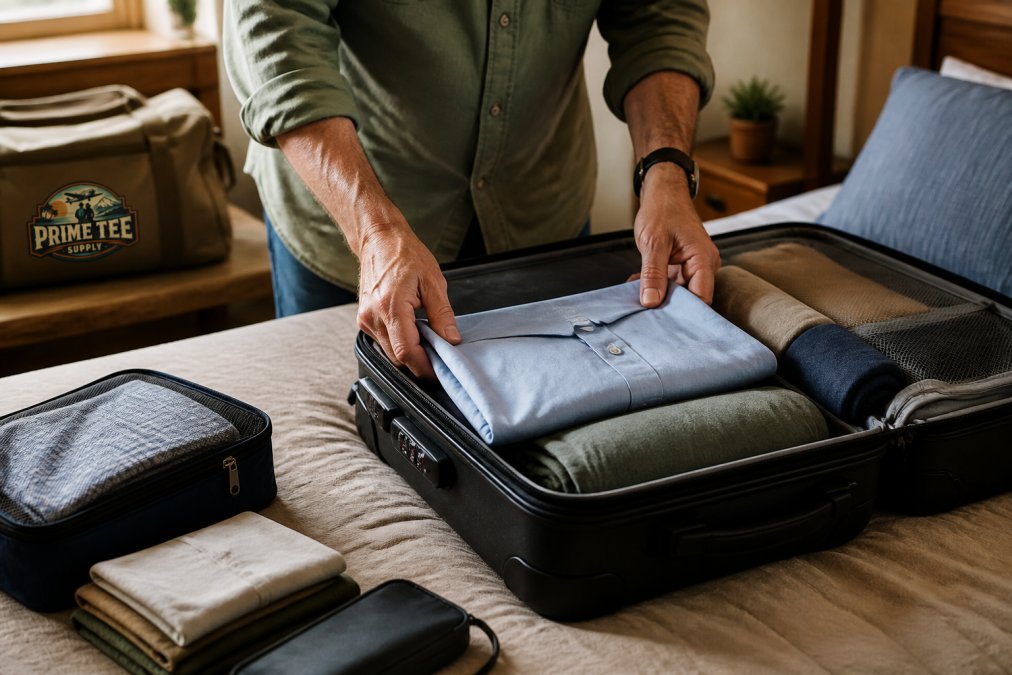
Packing well comes down to reducing pressure points and fold lines. The bundle method wraps garments around a core, so creases land on curves instead of sharp edges.
The Bundle Method and Other Folding Techniques
Start with the most wrinkle-prone item at the center and wrap softer pieces around it. Here is the sequence:
- Lay the shirt face down and smooth it flat.
- Fold the sleeves inward at the shoulders.
- Place a core item, such as a rolled towel or packing cube, near the collar.
- Fold the sides over the core, then roll the whole bundle.
- Tuck the bundle into the center of your bag.
Travel Apparel Care and Maintenance on the Road
Travel apparel care starts with reading the fiber content and washing gently. Most quick-dry and moisture-wicking shirts handle a sink wash and hang dry overnight, which keeps you packing light.
A few habits keep travel shirts in shape:
- Wash in cool water with a small amount of detergent.
- Skip fabric softener, which coats fibers and reduces moisture management.
- Hang to dry in a bathroom or near a window, away from direct heat.
- Shake the shirt out before hanging to release fold lines.
- Use a steamy shower to relax minor creases instead of an iron.
Weight-to-Wrinkle Ratio: Finding the Sweet Spot for Carry-On Travel
A useful way to judge a travel shirt is its weight-to-wrinkle ratio: how much fabric weight you carry versus how well it resists creasing. Abstract as it sounds, it translates into a concrete packing decision once you know the ranges.
Reading Fabric Weight
Fabric weight is measured in grams per square meter, usually written as GSM. Travel shirts cluster into three rough bands:
- Lightweight (roughly 100-140 GSM). Cool, packable, and quick to dry. The trade-off is that thin fabric creases more readily and can look flimsy in a dressier setting.
- Mid-weight (roughly 140-180 GSM). The carry-on sweet spot. Enough body to hold its shape in a packing cube, light enough to dry overnight in a hotel bathroom.
- Heavyweight (roughly 180-220 GSM). Excellent crease recovery and a substantial drape, but slower to dry and warmer to wear. Better for cool-weather trips than for the tropics.
Why Weight Alone Does Not Decide
Two shirts at the same GSM can behave very differently depending on fiber and weave. A 150 GSM merino knit recovers from compression far better than a 150 GSM cotton poplin, because the fiber itself springs back. A tight plain-weave polyester at 130 GSM can outperform a loose 170 GSM cotton oxford, because the weave resists yarn shifting.
Matching Weight to Trip and Climate
A few practical pairings:
- Warm, humid destinations. Lightweight synthetic or merino blends in the 110-140 GSM range. They dry fast, breathe well, and hang out smooth overnight. Heavier wrinkle-free shirts can feel oppressive in this climate.
- Cool-weather city travel. Mid-weight blends in the 150-180 GSM range. They layer well under a sweater or jacket and hold their shape through repeated packing.
- Multi-week trips with limited laundry. Mid-weight merino or a mid-weight synthetic blend. The extra body helps the shirt survive more wears between washes without looking tired.
- Formal or dressy occasions. A slightly heavier shirt, 160-190 GSM, drapes better and reads as more polished than a very light one.
Stretch Changes the Math
A small amount of elastane or spandex, often 3 to 8 percent, lets a lighter fabric recover from compression the way a heavier one would. That is why a 130 GSM polyester-elastane blend can pack as well as a 170 GSM cotton shirt while taking up noticeably less room: the stretch does the work weight otherwise would.
A Note on Packing Space
Weight and volume are not the same thing. A heavier knit can compress into less space than a lighter woven, because knits squash and wovens hold their shape. For carry-on-only travel, judge a shirt by how small it packs and how it looks on arrival, not by GSM alone. The best travel shirt disappears into your bag and reappears looking like it just came off a hanger.
Odor Resistance and Sustainability in Modern Travel Shirts
Odor resistance and sustainability have moved from niche features to mainstream expectations. Merino wool resists odor naturally, and some synthetics now build antimicrobial treatments into the fiber rather than applying them as a coating.
Frequently Asked Questions
What fabrics are best for travel shirts that do not wrinkle?
The most reliable options are synthetic blends and performance fabrics. Look for a mix of polyester and elastane (spandex) for stretch and shape recovery, or nylon blends for durability. Merino wool is another excellent choice because its natural crimp resists creasing and it regulates temperature well. Tencel lyocell, a sustainable fiber from wood pulp, also performs well. Check the fiber content label and look for terms like 'wrinkle-resistant,' 'no-iron,' or 'permanent press' to confirm the fabric has been treated or constructed for low-maintenance wear.
How do I pack shirts without wrinkling them in a suitcase?
Start by choosing wrinkle-resistant fabrics, which do most of the work. Then use the bundle method: lay shirts flat, fold sleeves inward, and stack them in alternating directions before folding the whole bundle once and placing it in the center of your suitcase. This distributes pressure evenly and minimizes sharp creases. You can also roll casual shirts, place tissue paper between folds, and use packing cubes to keep everything compressed. Always unpack and hang shirts as soon as you arrive to let minor creases relax.
Do wrinkle-resistant travel shirts require special washing instructions?
Most wrinkle-resistant shirts are easy-care, but a few habits extend their life. Wash in cold water on a gentle cycle to protect any chemical finish or fiber structure. Avoid fabric softener, which can coat fibers and reduce moisture-wicking and odor-resistant properties. Tumble dry on low or hang to dry; high heat can break down elastane and shrink synthetic blends. If you iron, use the lowest setting that works. Always check the care label, since merino wool and some performance fabrics have specific requirements.
What features should I look for in a travel shirt for long-haul flights?
Prioritize breathability, moisture-wicking, and stretch. A shirt with a bit of elastane moves with you and resists creasing when you sit for hours. Look for antimicrobial or odor-resistant treatments if you plan to wear it more than once between washes. UPF protection is a bonus for sunny destinations. A relaxed but neat fit works for both the plane and a casual dinner. Finally, check that the shirt is lightweight and packable so it takes up minimal space in your carry-on and layers easily under a sweater or jacket.
The challenge with travel clothing is balancing comfort, packability, and looks without overthinking it. Prime Tee Supply makes that easier with soft, breathable graphic tees built for travelers who care about where they are going. Our shirts offer a unisex fit for everyday comfort, travel-inspired designs, and easy-care fabric that layers well across seasons. Get started with Prime Tee Supply and pack a wardrobe that keeps up with your itinerary.