

Table of Contents
- Why Shirt Selection Matters for Your Europe Trip
- Understanding Fabric and Fit for Women's Travel Shirts
- Building Versatile Europe Travel Outfits for Women
- Choosing Graphic Tees for Travel That Reflect Your Style
- Matching Shirts to Your Itinerary and Activities
- Practical Shirt Count and Laundry Planning
- Frequently Asked Questions
Last Updated: October 15, 2026
Why Shirt Selection Matters for Your Europe Trip
When you choose shirts Europe trip, it's more than grabbing a few basics. The shirts you select become the foundation of how you move through cafés, museums, train stations, and village squares, cobblestone streets, dinners with new friends, markets you stumbled upon.
The difference between a shirt that works and one that doesn't comes down to three things: how the fabric feels against your skin all day, how it fits without fussing, and whether it coordinates with everything else you've brought. On a two-week trip, these details matter far more than they do at home.
Your shirts do real work when you choose shirts Europe trip: keeping you comfortable on long walking days, helping you feel put-together at evening meals, and layering easily when the weather shifts. Getting this right means fewer regrets and more confidence in how you look and feel.
Understanding Fabric and Fit for Women's Travel Shirts
Start With the Fabric Hand Test
Before committing to a shirt for a two-week trip, put it through a few simple checks. They take about two minutes in a fitting room and tell you more than any hangtag.
Breathability. Hold the fabric up to a window. If light passes through evenly, air will move through it too.
Wrinkle recovery. Ball the shirt in your fist for ten seconds, then smooth it with your palm.
Opacity. Hold the fabric up to light with your fingers behind it. If you can see the outline of your hand, the shirt will show what's underneath in bright Mediterranean sun.
Dry time. Thick cotton terry and heavy knits hold water and take a full day or more to dry on a hotel towel rack. Lighter cotton, linen, and cotton-linen blends dry faster.
Cotton, Linen, and Blends: What Each One Does Well
Cotton is the most forgiving all-rounder. It breathes, softens with washing, and hides minor wrinkles better than linen. Ring-spun cotton is softer and more durable because the fibers are twisted tighter before spinning.
Linen is the coolest option in genuine heat. It moves air better than cotton and dries faster. Its trade-off is creasing; many travelers decide the texture is part of the look. A linen shirt reads as intentional in a café in Seville or a market in Provence.
Cotton-linen blends split the difference: most of linen's airflow with more of cotton's structure and wrinkle resistance. For a trip spanning cool mornings and warm afternoons, a blend is often the most versatile single shirt you can bring.
Fit Guidance for Different Body Types
A well-fitting shirt makes all the difference on a long day of sightseeing.
Petite frames. Standard-length shirts often hit mid-thigh and swallow the silhouette. Look for a shorter body length, or plan to tuck or knot the hem.
Tall frames. The opposite problem: hems that ride up when you raise your arms and sleeves that stop short.
Plus sizes. Fit through the bust and upper arm is where most shirts fail.
Unisex or boyfriend-cut shirts work well for travel because they accommodate different body shapes without requiring perfect sizing.
Sleeves matter too. Short sleeves give you freedom in warm weather and layer well under jackets; cap or flutter sleeves add visual interest without bulk.
Test the fit by raising your arms, bending forward, and sitting down. A good travel shirt doesn't pull or shift during normal movement.
Building Versatile Europe Travel Outfits for Women
Neutral Colors That Coordinate Easily
The most valuable shirts you can bring are neutrals: white, black, gray, cream, navy, and soft earth tones. They coordinate with everything else in your bag without thinking.
Neutral doesn't mean boring. Cream has more warmth than pure white; soft gray photographs better than harsh charcoal; navy is more forgiving than black for showing dust and wrinkles. Choose neutrals that feel good to you.
One or two patterned or colored shirts can add personality without compromising versatility. Stripes, small prints, or muted jewel tones work well. The key is choosing colors and patterns that pair with your neutral base pieces.
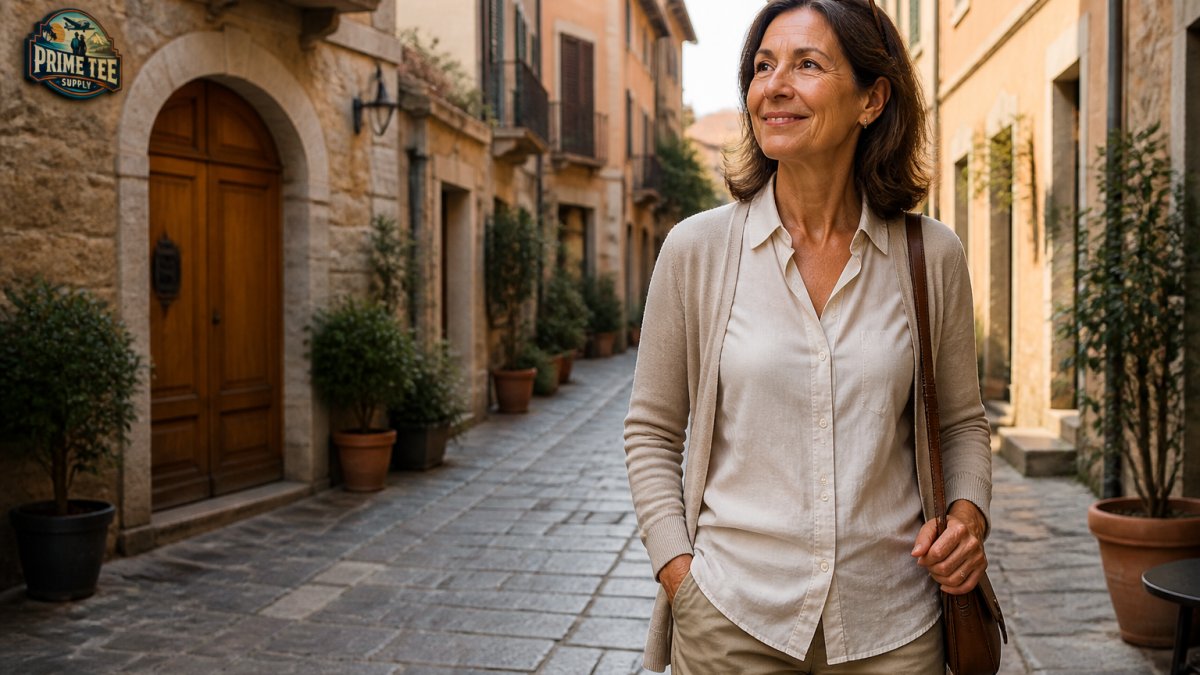
Layering for Variable Weather
Europe's weather changes. A warm morning becomes a cool afternoon. A sunny day shifts to clouds. Layering lets you adjust without carrying heavy outerwear.
Start with lightweight base layers, your cotton shirts, then add a thin cardigan, linen shirt, or structured jacket. These pieces fold small and add flexibility without taking up much space.
Choose layering pieces that coordinate with your shirt colors. A cream cardigan works with nearly everything; a denim shirt layers over patterned tees; a lightweight linen jacket adds evening polish while staying cool during the day.
The goal is adjustability: comfort whether you're walking in morning cool, sitting in an air-conditioned museum, or dining outside as the sun sets.
Choosing Graphic Tees for Travel That Reflect Your Style
Graphic tees add personality to your travel wardrobe while remaining practical. Unlike souvenir shirts with generic tourist imagery, tees with meaningful designs reflect who you are and what you love about travel.
Look for designs that resonate with your actual travel interests. If you love trains, a tee celebrating rail journeys means something. If you're drawn to Italian villages or the ritual of café culture, a design that captures that feeling becomes part of your travel identity.
Prime Tee Supply creates graphic tees for travelers like you, designs built around recognizable travel habits and destination loyalties. The Traveler T-Shirt features hand-drawn botanical line art and speaks to travelers who find beauty in the in-between moments. The One Bag Europe T-Shirt celebrates traveling through Europe.


Graphic tees work best printed on quality cotton. Look for soft, breathable fabric rather than stiff printing; the design should feel like part of the shirt, not something applied on top. A well-made graphic tee is one you'll actually wear.
Matching Shirts to Your Itinerary and Activities
Sightseeing and Walking Days
On days covering distance on foot, moving between neighborhoods, exploring museums, wandering markets, you need shirts that prioritize comfort. Cotton basics in neutral colors work best: something you don't mind getting slightly dusty or warm in.
Short-sleeved shirts work well for warm-weather walking: freedom of movement, and cool. Skip anything so loose it shifts around as you move, or with embellishments that might catch on things.
These are the days for your most durable, forgiving shirts, the ones that look fine even after a train ride or a long uphill walk.
Casual Dinners and Café Hours
When you're settling in for an evening meal or lingering over coffee, your shirt can be more relaxed. Slightly dressier basics work well: a well-fitting white shirt, a soft gray tee, or a patterned option that feels intentional.
Café hours often happen in air-conditioned or cooler evening spaces. This is when a layering piece becomes useful. A lightweight cardigan or shirt jacket adds polish without feeling heavy.
These are good moments for your graphic tees, especially ones that start conversations. A meaningful design worn with intention looks thoughtful rather than casual.
Smart-Casual Evenings
For nicer dinners or evening events, you want shirts that feel polished. A well-fitted white shirt dresses up easily and coordinates with everything; black also works for dressier occasions. Soft jewel tones or muted patterns add interest while staying sophisticated.
Pair these shirts with tailored pieces, a structured jacket or blazer. The goal is looking put-together without looking like you tried too hard.
Quality matters more at this level. Clean seams, an even hem, and quality printing or dyeing make the difference between looking intentional and looking like you grabbed whatever was clean.
Practical Shirt Count and Laundry Planning
How many shirts do you actually need? The honest answer depends on three variables: trip length, laundry access, and climate.
Match the Count to Your Laundry Access
Laundry every 3-4 days (apartment rental, hotel service, or a nearby laundromat). Bring 4-5 shirts for any trip length. You'll cycle through them and wash mid-week, the most flexible scenario, and the one most experienced travelers plan for.
Laundry every 7-10 days. Bring 6-7 shirts: enough rotation to avoid wearing the same shirt twice in a row, and enough variety for different activities and weather.
Laundry once, or not at all (a short trip or a remote itinerary). Bring 7-8 shirts for a two-week trip, or 4-5 for anything under a week. Add one extra in genuine heat if you expect to change midday.
A useful rule of thumb: count the days between laundry sessions, then add two. The extras cover a spill, an unexpected warm day, or a laundry day that doesn't go as planned.
A Sample Rotation for a Two-Week Trip
If you're doing laundry every 7-10 days, a rotation like this covers nearly every scenario:
- 2-3 neutral basics (white, gray, or cream)
- 1-2 darker neutrals (black or navy)
- 1-2 graphic tees or patterned options
- 1 slightly dressier option for evening plans
That's 5-8 shirts depending on how many you double up. The neutrals do the heavy lifting; the graphic tees and dressier option add range without much weight.
How Climate Shifts the Math
In a hot, humid climate you'll change shirts more often, so lean toward the higher end of each range and favor lighter fabrics that dry quickly. In a cool climate you'll wear each shirt longer between washes, so lean toward the lower end and bring one warmer layer.
Planning Your Laundry Before You Go
Research where you'll do laundry before you arrive. Some hotels offer same-day service; some apartments have a washer but no dryer; some neighborhoods have small laundromats that are part of the local rhythm. Knowing which applies to each stop removes the guesswork.
Many experienced travelers do laundry mid-trip, around day 6 or 7, so the second half feels as fresh as the first; others wash at the end. Either works, the point is to decide in advance rather than improvise on a travel day.
When you do wash, use cool water and hang shirts to dry when you can; this keeps colors and fit looking newer longer. A lightweight cotton or cotton-linen shirt hung near an open window is often ready within a few hours.
Frequently Asked Questions
What kind of shirts are comfortable for sightseeing in Europe?
Look for lightweight, breathable cotton shirts that allow air circulation as you walk for hours. A relaxed, true-to-size fit prevents restriction and chafing. Ring-spun cotton, pre-shrunk and around 4.5 oz weight, offers durability through repeated washing while staying soft and easy to wear all day. Avoid overly tight or structured styles that feel confining after several hours of walking.
How should a woman choose shirts for a Europe trip?
Start with neutral solid colors, whites, blacks, grays, and soft pastels, that mix and match effortlessly. Choose versatile basics in breathable cotton, then add one or two graphic tees that reflect your travel personality. Consider your itinerary: casual sightseeing calls for comfort, while café hours and dinners benefit from slightly more polished options. Prioritize fit over trend; a true-to-size unisex cut works across different body types and layers well over other pieces.
What colors are easy to coordinate in travel outfits?
Neutral colors, black, white, gray, cream, and soft blue, form the foundation of a coordinated travel wardrobe. These pair with almost everything and hide minor stains during travel. One or two accent colors, such as soft pink or olive, add visual interest without complicating combinations. Solids are far easier to mix than prints, though a quality graphic tee with a simple design can anchor multiple outfit combinations.
How do you choose a graphic tee for a Europe trip?
Select a graphic tee that speaks to your travel identity rather than generic tourist imagery. Look for designs that reflect recognizable travel habits, favorite destinations, or personal rituals, something that feels authentic to who you are as a traveler. Ensure the graphic tee is made from the same quality cotton and fit as your basics, so it layers and washes as reliably. A single well-chosen graphic tee can become a signature piece throughout your trip.